Orb pythons
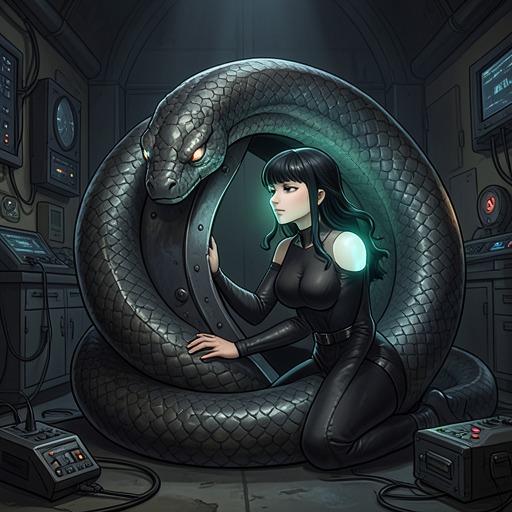
The Stars Have EyesOrb pythons are a purpose-bred companion species designed for the latest, space-faring iteration of humanity. Smaller and more docile than ordinary ball pythons, they retain enough feistiness and curiosity to remain engaging pets without the danger associated with more formidable constrictors. In the story, the species is represented by Azgod’Kalar the Calm, a tiny gold-and-brown serpent whose presence gradually exposes the difference between an animal treated as an experimental object and one recognized as a companion with a place in a household.
Species and Physical Characteristics
Orb pythons belong to a broader human program of deliberate biological adaptation. Their kind was genetically modified, along with more than a hundred other species, to make animals suitable companions for a technologically advanced civilization. Project BFF emerged from humanity’s serious attempt to prevent people from adopting uniquely dangerous extraterrestrial life simply because it appeared cute. The modifications therefore combine aesthetics and safety: the snakes are markedly smaller, less aggressive, and more manageable than their larger relatives, while still displaying recognizable reptilian behavior.
Azgod’Kalar’s appearance makes that design immediately concrete. The young snake has gold-and-brown patterned scales and is small enough to sit comfortably in Maggie’s open palm. When loosely coiled, it measures approximately the distance from Joe Mulligan’s elbow to his wrist, with a girth about equal to his thumb. Its tiny forked tongue flicks repeatedly as it tastes the air, and its inquisitive head movements parallel Maggie’s own relentless interest in unfamiliar phenomena. The animal is therefore presented as both an engineered product and a living creature whose behavior exceeds a simple catalog description.
Acquisition and Early Role
Maggie encounters the species while investigating the near-total absence of animal life around mega-city Dave-156. After observing that the surrounding industrialized environment contains no birds, rats, or cockroaches within a broad radius, she refuses to search for an immediate online explanation. Instead, she follows a clue supplied by Edith Mandrake, Joe Mulligan’s next-door neighbor, and visits a pet business operated by Eugene Charles.
Charles’s warehouse contains eight available animals, including mammals, reptiles, birds, and a vividly colored tarantula. Maggie’s analytical assessment identifies the miniature giant space hamster as the cutest by purely scientific standards, estimating that 96 percent of humans would find an appealing companion in the selection. Yet scientific ranking does not determine her choice. She selects the small gold-and-brown snake because it is personally precious to her, even though the hamster remains the objectively more adorable candidate by her own stated criteria. The purchase benefits everyone involved: Maggie fulfills her promotional obligations to Charles, more than seventy potential customers visit the store within two hours, at least half make purchases, and she leaves with the serpent rather than accepting Charles’s offer of permanent employment.
When Maggie returns, she presents the snake to Joe as an object whose ownership she has legitimately secured during their separation. A glass terrarium and a large bag of food pellets are already waiting beside the Full Immersion Pod 3,000™, indicating that the animal’s basic needs have been considered from the start. Maggie names it Azgod’Kalar the Calm, using the full name associated with Azgod’Kalar the Calm elsewhere in the household’s strange network of relationships.
Experiment, Attachment, and Development
Azgod’Kalar initially enters Maggie’s life as a candidate in a fear experiment. Maggie wants to study the fear of losing another being, but she rejects the shoggoth inhabiting the Full Immersion Pod 3,000™ because its destruction would cause only disappointment over wasted effort. The snake, by contrast, is innocent, practically insignificant, and of no obvious use to her, yet its arbitrary selection begins to reveal that emotional investment can arise independently of utility. She takes the animal to the one-hundred-ninetieth floor of the hyper-scraper, opens a person-sized gap in shatterproof glass by bending its molecules, and steps into the freezing air with the unsuspecting snake in hand. Azgod’Kalar retreats up her sleeve while Maggie remains unaffected by the wind.
The experiment does not leave the relationship unchanged. Maggie becomes increasingly attached to the mortal reptile and recognizes that its eventual death will cause unpleasantness. Rather than treating that anticipated loss as a reason to withdraw, she chooses to enjoy the animal’s company in the present. Her attachment is visible in the way she carries Azgod’Kalar during travel: on the supersonic vacuum-tube train from Dave-156 to Dave-157, the snake remains tucked inside her left sleeve, with its head emerging near her shoulder. The train’s serpent-like shape amuses her, though she distinguishes it from Azgod’Kalar because the machine is neither alive nor small enough to fit in her hand.
Joe later asks whether the snake will grow into a powerful constrictor. Maggie explains that the subspecies has had most of its ferocity surgically removed, and that its hunting behavior depends on suffocation or interruption of blood circulation rather than simple crushing force. Joe responds with confidence unsupported by evidence that Azgod’Kalar will grow big and strong under such an incredible owner. Maggie accepts that hope, and the word becomes unusually natural to her. Her smile and her interest in the snake’s physical and mental development mark a movement beyond detached observation: she is no longer studying only what the creature can teach her, but anticipating its future as an individual.
That development includes deliberate training. When Joe asks about the snake’s abilities, Azgod’Kalar emerges from behind Maggie’s neck, coils the end of its tail into a spring-like shape, and raises it in imitation of Maggie’s thumbs-up gesture. The trick is amusing, but its implications are unsettling: the engineered companion has become responsive to instruction in a way that further blurs the line between pet, study subject, and participant in the household’s communication. Maggie has taught a snake to perform, yet the scene also gives Azgod’Kalar a recognizable capacity for attention and learned response.
Permanence and Household Significance
Azgod’Kalar’s fate is ultimately altered by Maggie’s power. When Joe later notices that the snake has not grown despite having been a hatchling when acquired, Maggie explains that she has granted it perpetual youth. The revelation confirms that the animal will not follow the ordinary developmental and mortal trajectory Maggie once expected. It also retroactively changes the fear experiment: the creature chosen because its eventual death might provoke genuine fear has been removed from ordinary aging, making continued companionship possible while preserving the strange ethical tension of an immortalized pet.
The snake’s importance is reinforced by the wider household infrastructure. Maggie’s possessed Full Immersion Pod 3,000™ contains the essence of a shoggoth, a durable Class-1 cosmic entity that she trained to act with greater subtlety and entrusted with protecting Joe while she was away. The pod is thus a powerful guardian, while Azgod’Kalar is a small, emotionally valued companion. Their contrast matters: the technologically transformed machine is useful because of its strength and durability, whereas the snake becomes important precisely because it is not practically necessary. Joe likewise reorganizes his home around Maggie’s unusual behavior, disabling wireless devices and keeping virtual-reality pods offline, while retaining Jeeves as a permitted domestic automaton. Within this network of modified organisms, machines, and human caretaking, Azgod’Kalar is the most visibly domestic presence.
Narrative Function
Orb pythons embody the book’s unstable boundary between nature, manufacture, and relationship. They are not wild animals encountered outside human systems; they are products of genetic engineering, commercial distribution, and a safety project intended to regulate human attraction to dangerous life. Nevertheless, Azgod’Kalar repeatedly exceeds the status of a commodity. Maggie chooses the snake against her own scientific ranking, subjects it to a dangerous test, carries it across cities, teaches it gestures, anticipates its maturation, and finally grants it perpetual youth. Joe’s fondness for the animal grows alongside his acceptance of Maggie’s increasingly impossible revelations.
The species also provides a compact measure of Maggie’s transformation. Her early reasoning treats affection as a variable that can be isolated and fear as a phenomenon to be induced under controlled conditions. Azgod’Kalar becomes the evidence that such feelings can survive the experiment and alter the experimenter. The serpent remains tiny, engineered, and trained, but it is no longer merely a specimen. Through its recurring appearances—coiled in Maggie’s hand, hidden in her sleeve, tasting the air before Joe’s face, mimicking a gesture, and preserved in perpetual youth—the orb python becomes a companion species in the fullest narrative sense: a being whose presence helps create the household and reshape the emotional life of the cosmic entity who claimed it.